Table of contents
1. RecruitAbility
1.1. About the Scheme
We participate in the APS RecruitAbility scheme to support people with disability to showcase their skills and experience during recruitment. RecruitAbility is a scheme that provides eligible applicants with the opportunity to progress to a further stage of the selection process when they meet the minimum job requirements.
All externally advertised vacancies, including SES roles, are accessible under the scheme.
The APS merit principle continues to apply to all engagement and promotion decisions.
1.2. Eligibility
You are eligible to participate in RecruitAbility if you:
• identify as a person with disability
• choose to opt into the scheme when submitting your application
• meet the minimum requirements for the job.
1.3. Definition of disability
Disability is defined as a limitation, restriction or impairment that has lasted, or is likely to last for at least six months and restricts everyday activities. This includes conditions such as vision or hearing loss, speech difficulties, breathing problems, chronic pain, blackouts, learning difficulties, reduced mobility, mental illness requiring support, long-term effects of injury or brain damage, or any other long-term condition resulting in restriction.
1.4. How to opt in
You can opt in when submitting your application by answering ‘Yes’ to the question confirming you are a person with disability and choosing to participate in RecruitAbility. No additional evidence or documentation is required when opting in.
1.5. Minimum requirements
You meet the minimum requirements of the vacancy if you:
- satisfy essential job criteria as outlined in the position description
- meet mandatory qualifications, registrations or clearances
- can perform the inherent requirements of the job, with reasonable adjustments if required.
1.6. Selection process
If you opt in and meet the minimum requirements, you will progress past the initial shortlisting stage to a further assessment (e.g., interview or work sample). After this, the standard merit-based selection process applies to all candidates.
1.7. Reasonable adjustments
We provide reasonable adjustments throughout recruitment and employment, including access supports, equipment, modified assessments or other assistance. You may request adjustments at any point by contacting HR@apvma.gov.au. Adjustments are available regardless of whether you opt into RecruitAbility.
1.8. Additional resources
- RecruitAbility Guide for Applicants – Australian Public Service Commission (APSC)
- Reasonable Adjustment Policy – APSC
- APVMA current vacancies
1.9. Contact us
People and Culture
Careers, Recruitment and Graduate Development
Email: HR@apvma.gov.au
2. Guiding Principles for AI Use
We acknowledge that AI tools can support candidates in preparing for recruitment activities. However, to maintain the integrity of our processes and uphold public trust, candidates are expected to adhere to the following principles:
2.1. Honesty and transparency
- Ensure all information provided reflects your own skills, experiences, and achievements.
- Ensure responses in applications, assessments, and interviews are based on your personal knowledge and capabilities.
- If you use AI tools to assist in your application, you must disclose this.
As part of your application, you will be required to complete the below acknowledgement
Image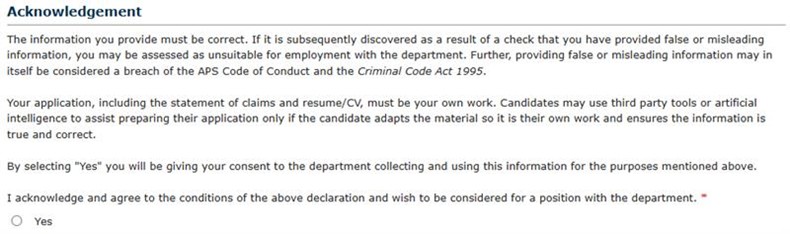
- Be clear about how AI contributed to your application materials or preparation.
2.1.1. Why this is important
When candidates provide inaccurate or exaggerated information about their skills or experience, it undermines the integrity of the recruitment process. This can harm their professional reputation, result in failed background checks, and may lead to disciplinary action due to false or misleading representations.
2.2. Authenticity
- Demonstrate your personal insights and understanding of the role.
- During interviews and assessments, be prepared to discuss your experiences and skills without relying on AI.
- The recruitment process is designed to assess you, not the capabilities of AI tools.
2.2.1. Why this is important
Excessive reliance on AI tools during the application process to exaggerate or fabricate skills and experience can lead to poor performance in later recruitment stages. It may also result in an inability to meet the actual requirements of the role once hired.
2.3. Ethical awareness
- Misusing AI to gain an unfair advantage undermines the merit-based principles of APS recruitment.
- Candidates should avoid using AI in ways that misrepresent their abilities or circumvent fair assessment.
2.3.1. Why this is important
Using AI tools to gain an unfair advantage during recruitment undermines the merit-based principles that guide APS hiring. Ethical use of AI is essential, candidates must ensure it does not misrepresent their abilities or bypass fair assessment processes, preserving the integrity and fairness of recruitment.
2.4. Examples of acceptable AI use
To help you navigate AI use responsibly, here are some examples of both acceptable and unacceptable ways AI can be used during the recruitment process:
| Use case | Acceptable AI use | Unacceptable AI use | Your responsibility |
|---|---|---|---|
| Resume writing | Using AI to:
| Using AI to:
|
|
| Interview preparation | Using AI to:
| Using AI to:
|
|
| Researching the role or organisation | Using AI to:
| Using AI to:
|
|
| Writing Support | Using AI to:
| Using AI to:
|
|
2.5. Cautions and boundaries
2.5.1. Misrepresentation
Submitting AI-generated content that doesn’t reflect your actual skills or experience (e.g., copying answers verbatim from AI tools) is considered unethical.
2.5.2. Over-Automation
Over-reliance on AI for personalisation (e.g., generic responses lacking authenticity) can be a red flag for recruiters.
2.5.3. Transparency
You should be prepared to discuss how you used AI in your applications or portfolio. Transparency builds trust and shows tech-savviness.
2.6. Candidate commitment
By participating in the APVMA recruitment process, you are committing to:
- representing yourself truthfully
- engaging with the process ethically
- respecting the integrity of public service recruitment.
The APVMA remains committed to embracing innovation and efficiency in our recruitment processes. We acknowledge the value that Artificial Intelligence can bring when applied responsibly, ethically, and within clearly defined parameters. When used appropriately, AI enhances our ability to deliver timely, data-informed decisions while maintaining the integrity, fairness, and human-centered approach that underpins our recruitment practices. We will continue to support its use in ways that align with our operational standards and strategic goals.
2.7. More information
Useful guidance and resources:
How to spot an AI applicant | Australian Public Service Commission
Guidance material for using AI-assisted recruitment tools | Merit Protection Commissioner